

Prenatal · Newborns & feeding
Birth and the hospital stay: what happens to your baby
Your obstetrician or midwife leads the birth. Your baby gets a vitamin K shot, eye ointment, the hepatitis B vaccine, a newborn screen at 24 to 48 hours, a hearing test and a heart screen.
Key takeaways
- The obstetrician or midwife leads the labor and the birth; our part is your baby
- First hours: skin to skin, the first feed, vitamin K, eye ointment and the hepatitis B vaccine
- At 24 to 48 hours: the newborn screening heel stick, the hearing screen and the pulse oximetry heart screen
- Give the hospital our name at admission, then call or text (770) 615-7000 on the day you go home
- The first office visit is 2 to 3 days after discharge, for weight, jaundice and feeding
What should I pack for the hospital?
Hospitals supply diapers, wipes, a swaddle and usually formula, so the bag is shorter than it looks online.
- For you: toiletries, a long phone charging cable, lip balm, loose clothes to go home in, whatever you use to relax, photo ID and your insurance card.
- For your baby: a going-home outfit in two sizes, because birth weight is a guess until the day, a hat and a blanket.
- The car seat, installed and checked before 36 weeks. You cannot leave without one.
- Our details for the admission form: Dare2Care Pediatrics, 5460 McGinnis Village Pl, Suite 103, Alpharetta, GA 30005, (770) 615-7000.
- Snacks and water for whoever is with you.
A blanket or a small stuffed toy is fine for photos and the car ride. Neither goes in the sleep space. The AAP rule is back, alone, on a firm flat surface: a crib, bassinet or play yard with a fitted sheet and nothing else in it.
What do the stages of labor look like?
Your obstetrician or midwife leads the labor and the birth, decides about pain relief, and is who you call when contractions start or your water breaks. We are your baby’s doctors, so this is a map, not instructions. March of Dimes describes three stages.
- First stage, early labor. The cervix opens to about 6 centimeters, with mild contractions often 5 to 15 minutes apart. Commonly 6 to 12 hours with a first baby.
- First stage, active labor. Contractions about 3 minutes apart, the cervix opening from 6 to 10 centimeters, usually over 4 to 8 hours. Most people go in around now, and an epidural is decided here.
- First stage, transition. The last and hardest part, 15 minutes to an hour, with contractions 60 to 90 seconds long.
- Second stage, pushing and birth. From full dilation at 10 centimeters until your baby is out, as short as 20 minutes or as long as a few hours.
- Third stage, the placenta. The shortest stage, usually under 20 minutes, with easier contractions.
What is done for my baby in the first hours and days?
A healthy newborn is dried and put straight on your chest. Skin to skin keeps a baby warm, steadies heart rate and breathing and makes the first feed go better, and the AAP recommends it until that first feed is finished. Ask for it after a cesarean too.
- Vitamin K shot. One injection in the thigh within 6 hours of birth. Babies are born with very little vitamin K, and the shot prevents vitamin K deficiency bleeding, which can bleed into the brain or intestines. The AAP recommends the injection because the oral form is not absorbed reliably.
- Erythromycin eye ointment. A thin line in each eye shortly after birth. It prevents the newborn eye infection caused by gonorrhea, which can scar the cornea. Hospitals and birth centers in most states are required to give it.
- First hepatitis B vaccine. The AAP recommends the first dose within 24 hours of birth, because about 9 in 10 babies who catch hepatitis B around birth go on to lifelong infection. See our immunization schedule.
- Newborn screening heel stick. Required in Georgia: a few drops of blood on a card at 24 to 48 hours of age, sent to the Georgia Public Health Laboratory, which screens for more than 37 conditions. We go through the results at the first office visit.
- Hearing screen. Soft sounds played into each ear before discharge, usually while your baby sleeps. If your baby does not pass, the CDC recommends a full hearing test by 3 months, and we arrange it.
- Heart screen. Pulse oximetry after 24 hours of age, a sensor on the right hand and a foot, looking for critical congenital heart disease. It does not catch every heart defect, so tell us about a worry even after a passing screen.
- Weight, temperature and jaundice. Nurses weigh your baby, check temperature, count feeds and diapers, and measure bilirubin at least once before you leave.
Who examines my baby in the hospital?
Families in Alpharetta, Johns Creek and Cumming deliver at several different hospitals, so the hospital’s own newborn team examines your baby each day until discharge. Dr. Viswanadham and Adam Ayer do not round at the hospitals. When the admission form asks for a pediatrician, give our name: that is how the discharge summary and the screening results reach us.
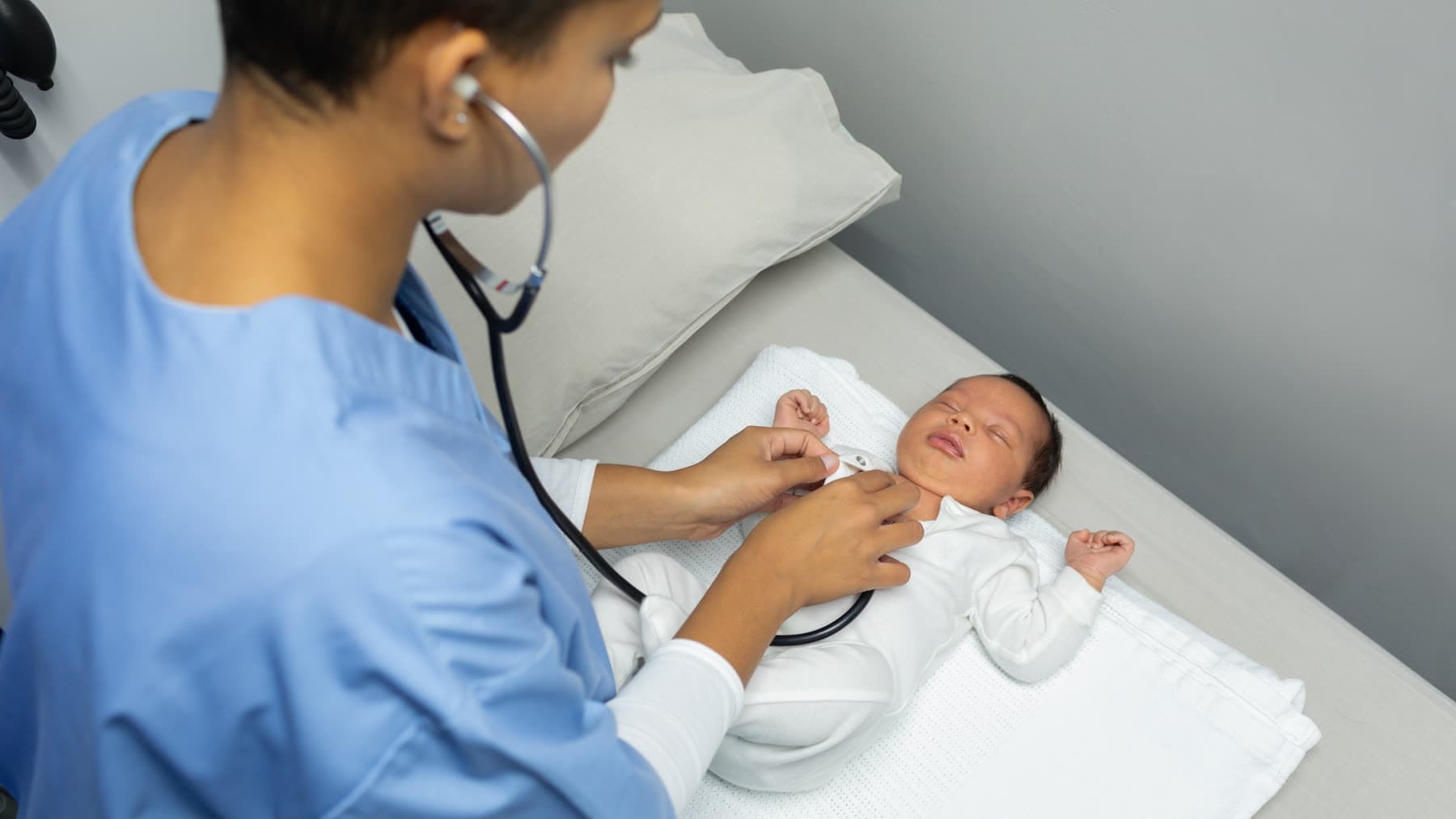
Call or text (770) 615-7000 on the day you go home. We book the first office visit for 2 to 3 days later and hold same-week slots for newborns. The AAP asks for that visit 48 to 72 hours after discharge, and it is where we check weight, jaundice, feeding and the newborn screen results.
How does feeding work in the first days?
The first milk is colostrum: thick, yellow and small in volume. A few teaspoons a feed is all a newborn stomach holds, and the amount climbs as your milk comes in around day 3.
Newborns feed often. Breastfed babies nurse roughly every 2 hours, about 10 to 12 times in 24 hours; bottle-fed babies every 2 to 3 hours, at least 8 times. Feed on hunger cues rather than the clock: rooting, licking the lips, a hand to the mouth. Crying is a late cue.
Diapers are the simplest check. In the first few days expect 2 to 3 wet diapers a day, and from about day 4 at least 5 to 6 wet diapers and 4 stools. Every newborn loses weight in the first week, and most are back to birth weight by about 2 weeks.
Ask for the hospital’s lactation consultant on your first day, not your last. At home we check feeding at every early visit, and a latch check takes about ten minutes and can be booked on its own. Georgia WIC offers breastfeeding peer counselors.
What is jaundice, and when should I call you?
Jaundice is a yellow color in the skin and the whites of the eyes, caused by bilirubin building up faster than a new liver can clear it. Most newborns have some. It shows in the face first and moves down the chest, belly, arms and legs as the level rises.
Every baby has at least one bilirubin measurement before discharge, by skin meter or blood test. If the level is high for your baby’s age in hours, the hospital uses phototherapy, which is light rather than medicine. Levels often keep climbing for a few days, which is part of why we see your baby 2 to 3 days after discharge.
Call us if the yellow spreads to the belly or the legs, if the whites of the eyes look yellow, if your baby is very sleepy and hard to wake for feeds or is feeding poorly, or if jaundice is still there after 2 weeks in a formula-fed baby or 4 weeks in a breastfed baby.
What happens when we go home?
- The car seat is rear-facing from the first ride home, and stays rear-facing until your child reaches the seat’s height or weight limit. Harness slots at or below the shoulders, straps snug, retainer clip at the center of the chest.
- No bulky coats or snowsuits under the harness. Thin layers, buckle the harness, then a coat or blanket over the top.
- Bring the discharge papers, the feeding and weight record, the newborn screening information and your insurance card to the first visit.
- Ask for the last bilirubin value and the time it was taken. We use both.
If your baby will be on Georgia Medicaid or PeachCare for Kids, four things have to happen for coverage to follow the birth: give the hospital our details, confirm your baby is covered from the birth month, report the birth to your plan and to DFCS, and name Dare2Care Pediatrics as your baby’s primary care provider. The numbers and the sources are on our expecting a baby page.
What is different after a cesarean?
For your baby, nothing. The same skin to skin, vitamin K, eye ointment, hepatitis B dose, screens and checks, on the same schedule. Ask for skin to skin in the operating room or in recovery, and ask for help with the first latch: holding a baby across a fresh incision is awkward, and a football hold or a side-lying position keeps the weight off.
For you, a cesarean is abdominal surgery. March of Dimes says to expect 2 to 4 days in the hospital and 4 to 6 weeks for full recovery. Walk within 24 hours if your provider agrees, which helps the bowels restart and lowers the risk of blood clots, and skip heavy lifting for several weeks. Call your obstetrician for a fever, or swelling, spreading redness or growing pain at the incision.
When to call us
- Fewer wet diapers than you were told to expect: under 5 to 6 a day once your baby is 4 days old
- Your baby is too sleepy to wake for feeds, or falls asleep after a few minutes at every feed
- Yellow spreading down to the belly or the legs, or yellow in the whites of the eyes
- Jaundice still there after 2 weeks in a formula-fed baby, or 4 weeks in a breastfed baby
- Feeding hurts, your nipples are cracked or bleeding, or you do not think your milk has come in by day 4
- Your baby has not regained birth weight by about 2 weeks, or is vomiting after every feed
- Any newborn question, day or night. After hours the main number goes to our after-hours line.
Go to the emergency room or call 911 if…
- A rectal temperature of 100.4°F (38°C) or higher in a baby under 2 months. The AAP says to call immediately at that temperature in any baby 3 months or younger, even with no other symptoms. Go to the emergency room.
- Trouble breathing: fast breathing, grunting, flaring nostrils, or skin pulling in between the ribs
- Blue or gray lips, tongue or face
- A baby who is limp, cannot be woken, or will not feed at all
Questions parents ask
Will Dr. Viswanadham see my baby in the hospital?
No. Families deliver at many different hospitals, so the hospital’s newborn team examines your baby before discharge. Tell them Dare2Care Pediatrics is your pediatrician, then call or text (770) 615-7000 to book the first office visit 2 to 3 days after you go home.
Can I decline the vitamin K shot or the eye ointment?
You can ask questions about both, and we would rather you asked before the birth than in the delivery room. We recommend the vitamin K injection for every baby: vitamin K deficiency bleeding is rare, sudden and can bleed into the brain, and the oral form is not absorbed reliably. Eye ointment is required of hospitals and birth centers in most states. Bring this to the free prenatal visit and we will go through it.
My baby needs the NICU. What changes?
The neonatologists lead care while your baby is admitted, and the screens and vaccines happen on a schedule that fits your baby. We receive the discharge summary and pick up care when your baby comes home. Call or text us on the discharge day as you would after any birth.
What if my baby is born before we have had the prenatal visit?
Call or text (770) 615-7000 and we will book the newborn visit. The free meet-and-greet is useful, not required, and you can still come to the monthly newborn workshop afterwards.
Not sure? Ask us
Call or text the office during hours, or send a portal message. For emergencies call 911.
(770) 615-7000